
Springtime is all about bright colors, new beginnings, and creativity. What better way to welcome the season and have some Easter-themed fun than decorating eggs? This blog provides a step-by-step guide to making three easy Easter crafts that the whole family will love!
Blowing Eggs
Before starting any of our Easter egg DIYs, you’ll need to remove the yolks from all the eggs you’ll be working with.
What You’ll Need:
- Eggs
- Pin (you can also use a needle or sharp metal skewer)
- Cocktail stick or wooden skewer
- Paper clip (optional)
- Bowl
Step 1: Using your pin or needle, carefully poke a hole in the top and bottom of your egg. Gently insert your cocktail stick or skewer into the hole to gradually increase its size. The hole in the bottom of the egg needs to be big enough for the yolk to pass through, but be careful not to crack the egg in the process.
Step 2 (Optional): Use a straightened paper clip to “stir” the yolk inside the egg, making it easier to blow through the hole you made.
Step 3: Hold your egg over a bowl and blow as hard as you can into one of the holes in your egg. The yolk should start coming out the other end. You won’t need the yolk for these projects, but you can set them aside to use for cooking later!
Step 4: Now that the yolks are out of the eggs, rinse them under hot tap water to remove any residue. Once rinsed, leave the shells out to dry.
DIY #1 – Painting Eggs
Test your painting skills by getting creative with eggs! Paint stripes, patterns, splatters, and more! The design options for this DIY are endless!
What You’ll Need:
- Eggs with yolks blown out
- Acrylic paint
- Cocktail stick or skewer
- Paint brushes
- Sponge (optional)
Step 1: Insert a cocktail stick or skewer into the bottom hole of your egg to keep it away from your fingers while you paint.
Step 2: Use paintbrushes or a sponge to apply paint to your egg. Get creative with this part!
Step 3: Let the paint dry while your egg is still on the skewer by holding the skewer in a glass.
Step 4: Once your paint is dry, add a second coat to brighten the colors or add more designs! Leave your egg on the skewer until you are done painting and the egg is dry.
DIY #2 – Dyeing Eggs
Use food coloring or natural dyes with ingredients from around your home to create beautiful, dyed eggs that are the perfect Easter decorations! We will teach you how to dye eggs using food coloring for this DIY.
What You’ll Need:
- Eggs with yolks blown out
- Vinegar
- Food coloring (your choice of colors)
- Measuring spoons
- Kitchen tongs
- Paper towels
- Heat-proof bowls (one bowl for each color of food coloring)
- Crayons (optional)
Step 1: Prep your work area by laying down paper towels to prevent food coloring stains.
Step 2: To make your dyes, bring some water to a boil, then add 1 teaspoon of vinegar and about 20 drops of food coloring. The more food coloring you add, the more vibrant your dye color will be. Pour your mixture into a heat-proof bowl deep enough to dip your eggs in.
Step 3 (Optional): You can use crayons to create fun patterns and designs by drawing directly on the egg before you dye it. The dye pigment will not stick to the wax, so whatever you draw will stand out after you dip your egg!
Step 4: When you’re ready to dye your egg, use a pair of kitchen tongs to submerge the egg into your bowl of coloring. Make multicolor eggs, striped eggs, patterned eggs – You can be as creative as you want with this part!
Step 5: Remove your eggs from the dye using your kitchen tongs and set them out to air dry when finished.
DIY #3 – Jello Filled Eggs
This DIY project is a fun way to make a tasty treat that can also be a great April fool’s prank! You can paint or dye your eggs before you add the Jello to add to the fun and make this a 2-part project or leave them plain and give someone a surprise when their egg turns out to be Jello!
What You’ll Need:
- Eggs with yolks blown out
- Packets of Jello (Your choice of flavor)
- A fine pastry tip
- Egg carton
- Duct tape
Step 1: Use a small piece of duct tape over the hole in the bottom of your eggs to seal it closed, then place your eggs tape-side down back into the carton.
Step 2: Follow the instructions on the package to prepare your Jello mixture. Try making different flavors to add variety to your eggs!
Step 3: Once your Jello mix is ready, insert a fine pastry tip into the top hole of your egg and carefully pour the liquid Jello into the egg. Be careful not to overfill the egg, as the liquid will be hot.
Step 4: Once you’ve filled all your eggs, place the carton in the fridge to allow the Jello to set. This should take 2-3 hours.
Step 5: Once the Jello has set completely inside your eggs, open the shells and enjoy this tasty Easter treat!
Have fun and get creative this spring using everyday kitchen items and eggs from your own backyard! From all of us at Feeds ‘n Needs, we hope you try these Easter DIYs and have a great time making them!
Sources:
https://www.marthastewart.com/275626/egg-dyeing-101
https://www.marthastewart.com/266591/blowing-out-an-egg
Tapping Maple Trees for Sap
There comes a time of year when the days begin to get warmer, and hope for spring is in the air. After a long, cold winter, these are the days we look forward to. The snow begins to melt, and the sap starts to flow within the trees. For many families in Canada, tapping trees in the springtime is an eagerly awaited annual tradition and an easy and fun way to collect sap to make homemade maple goodies.
Getting Started
Generally, sap begins to flow when the daytime temperatures rise above freezing (0 Celsius / 32 Fahrenheit) and nighttime temperatures fall below freezing. Typically, the season runs for 4-6 weeks, from around mid-February to mid-March. Sap only flows on warm days, so you may not get any on colder days.
Tapping trees is a relatively straightforward process and only requires a few supplies to get started:
- Power drill & drill bit
- Spiles
- Sap buckets & lids
- Hammer
Some of our local Feeds’n Needs stores carry a great selection of quality sap supplies; be sure to check them out!
Before tapping trees each season, it is important to ensure your supplies are clean. A solution of 1 part unscented household bleach to 20 parts clean water can be used to clean your spiles, buckets, and lids.
Selecting Trees to Tap
When selecting which trees to tap, a maple tree with a high sugar content will produce the best sap for making syrup. Popular maple trees for tapping are sugar, black, red, and silver maples. Select healthy and mature trees with a diameter of at least 12″. Depending on the size, some trees can support more than one tap.
A general guide to follow when tapping trees:
- 12 – 20” = 1 tap
- 21 – 27” = 2 taps
- 27” = 3 taps
How to Tap Trees
Spile Placement: When tapping a tree, place your spile at least 3 feet from the ground and at least 6 inches away from any former tap holes. Tap above a large root or below a branch on the south side of the tree if possible, and if placing multiple taps on one tree, distribute the spiles around the tree’s circumference.
Drill a Hole: Most spiles require a 7/16 or 5/16 drill bit, but double-check to ensure that you use a drill bit that matches the size of your spile. Drill a hole about 2 to 2 ½ inches deep so that you hit the sapwood of the tree. Drill slightly upward to allow the sap to flow downward through your spile and into your bucket.
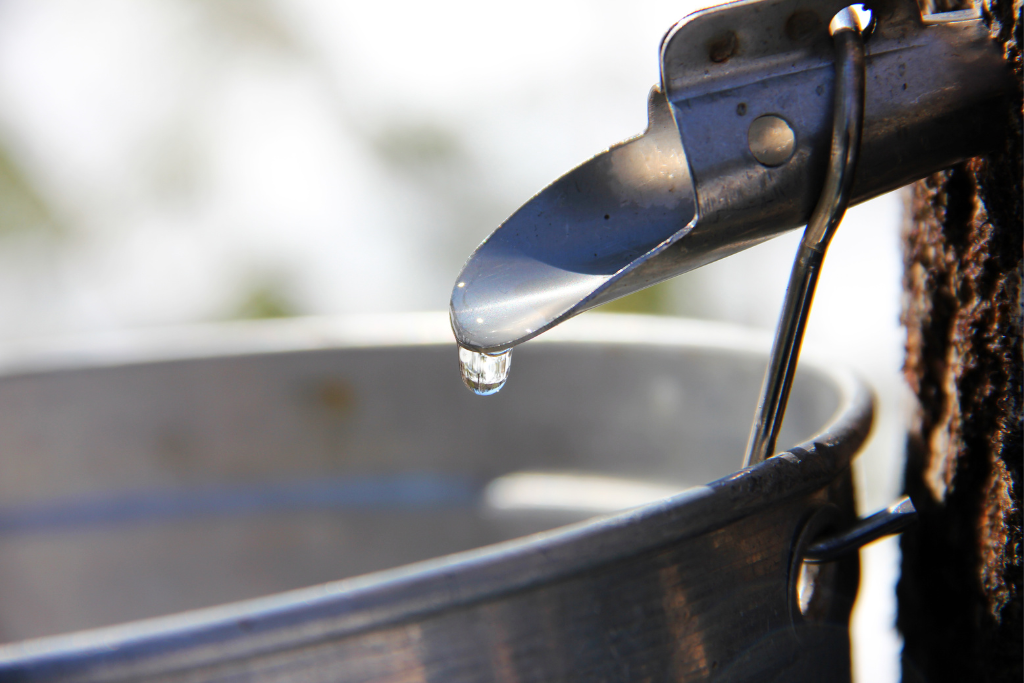
Insert Your Spile: Insert your spile into the tap hole you drilled. Then, gently tap the spile into place using a hammer so that it fits snugly within the hole. Once the spile is placed, you should begin to see sap start to drip or flow. Maple sap is clear and resembles water.
Hang Your Bucket: Hang your sap bucket by inserting the hook on the spile into the hole in the bucket’s rim. Attach a lid to prevent unwanted snow or debris from collecting in the bucket with your sap.
Sap can be collected until the temperature consistently stays above freezing or when buds begin to form on trees. Remove spiles and wash them to be stored for next season.
Once you collect your sap, keep it cold at 38 degrees Fahrenheit or 3.3 degrees Celsius until you boil it. Sap can be stored for up to 7 days at this temperature.
Now that you’ve learned how to tap trees to collect maple sap, you are well on your way to becoming an expert and enjoying this beloved Canadian tradition. Feel free to ask your local Feeds’ n Needs experts any questions you may have about tree tapping and sap collection. Be sure to check out our great selection of supplies to get you started!


